

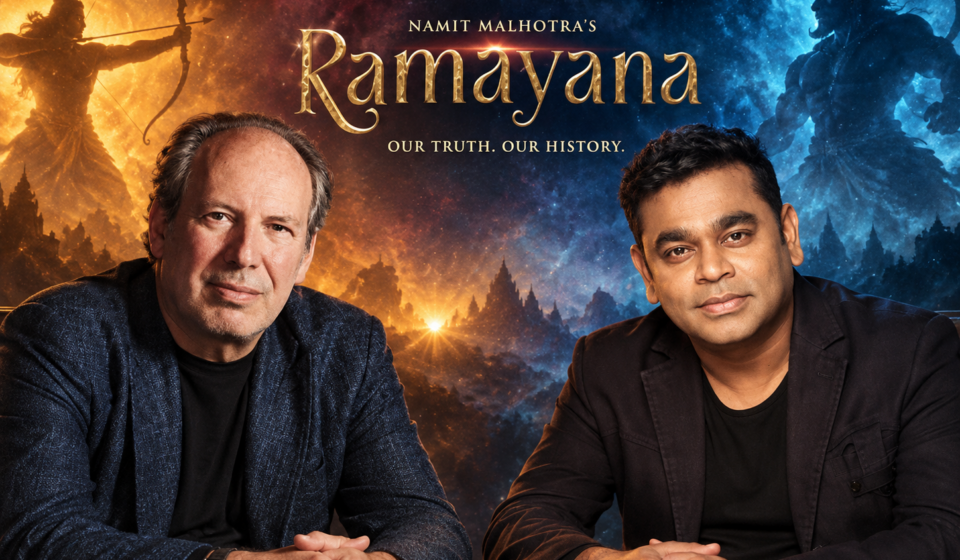
How Hans Zimmer Created the Music with AR Rahman for Namit Malhotra’s Ramayana: A Sneak Peek

Author: Rudranath Chakraborty
Namit Malhotra’s Ramayana has travelled a complicated road even before reaching theatres. The first teaser attracted considerable criticism over its CGI, colour grading and perceived lack of grandeur. Some viewers questioned whether the visual effects could match the enormous expectations surrounding the project. Producer Namit Malhotra subsequently defended the painstaking VFX process while Ranbir Kapoor also responded to what he called the rise of online “CG critics”.
The debate made every subsequent glimpse of the film more important. Directed by Nitesh Tiwari, the two-part epic stars Ranbir Kapoor as Rama and Sai Pallavi as Sita, with Yash as Ravana and Sunny Deol as Hanuman. Ranbir’s restrained portrayal of Rama and Sai Pallavi’s graceful screen presence as Sita have gradually become central to the film’s visual identity.
Ranbir and Sai Pallavi Have Finally Found Their World

The recently released material provides a closer look at Rama and Sita beyond the scale of battles and mythology. Their relationship receives particular attention in Jai Jai Ram, including moments connected with their marriage and Sita’s swayamvar. The song therefore works not simply as a promotional track but as an emotional introduction to the central relationship of the story.
Jai Jai Ram Changed the Conversation
Released on September 14, 2026, during Ganesh Chaturthi, Ramayana Jai Jai Ram song marks the beginning of the film’s musical campaign. A.R. Rahman composed and arranged the song, Dr Kumar Vishwas wrote the lyrics, while Arijit Singh and Shreya Ghoshal supplied the vocals. The composition combines the spiritual character of an aarti with the sweep of a modern cinematic arrangement.
Interestingly, the song has also helped shift the conversation around the film’s visuals. Viewers and entertainment publications have noted a significant improvement in the CGI and VFX compared with some of the earlier promotional material. The grand Ayodhya imagery, character detailing and larger cinematic frames have received considerable appreciation online.
The Sound Behind the Epic: From Hans Zimmer and A.R. Rahman

But the most intriguing story may be happening away from the camera. The Hans Zimmer and A R Rahman Ramayana music collaboration brings together two composers with remarkably different musical histories.
Rahman has described the responsibility as “terrifying” because they are working with a story that is both deeply familiar and culturally important. According to him, Zimmer initially created a soundscape for the promotional material. Rahman then built upon it, adding Sanskrit verses and Indian musical elements.
The idea is not simply to place Western orchestration behind an Indian epic. Rahman has explained that the musicians are attempting to “unlearn” conventional expectations of how Ramayana should sound while retaining the timeless quality embedded in the culture. That makes the collaboration particularly fascinating: Zimmer brings his enormous cinematic vocabulary while Rahman brings an instinctive understanding of Indian musical traditions.
Namit Malhotra’s Musical Gamble with the Combination of Zimmer and Rahman

Malhotra has explained that bringing Zimmer and Rahman together was a deliberate attempt to connect East and West. He grew up listening to Rahman’s music and later became deeply familiar with Zimmer’s Hollywood scores. His ambition was therefore to create a musical language capable of carrying an Indian story to a worldwide audience.
There is also an interesting behind-the-scenes dimension. Rahman has said that producer Malhotra remains closely involved and intensely curious about what the composers are developing, while director Nitesh Tiwari is also part of the creative discussion. Rahman has described his work with lyricist Kumar Vishwas as another important part of the process, praising Vishwas’s deep knowledge of the Ramayana and Hindi language.
A Devotional Song With a Global Ambition
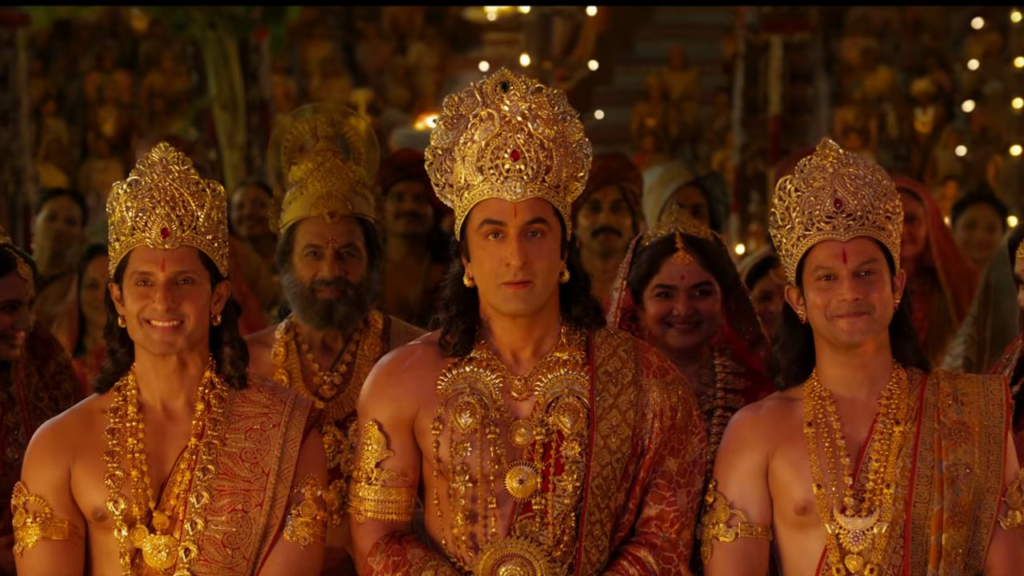
At the center of Ramayana Jai Jai Ram song is a deceptively simple idea: the repeated invocation of Shri Ram’s name. Rahman has described that simplicity as the heart of the composition. Arijit Singh and Shreya Ghoshal then give the devotional material contrasting emotional textures, allowing the track to feel intimate while still carrying cinematic scale.
Early reception has been encouraging. Audiences have praised Rahman’s composition, the singers and particularly the song’s peaceful devotional quality. Just as importantly, the improved visuals have suggested that the team has responded to earlier criticism and continued refining the film’s presentation.
The Bigger Musical Picture With The Ramayana
Ultimately, Ramayana is attempting something more ambitious than recreating a familiar mythological soundtrack. The Hans Zimmer and A R Rahman Ramayana music partnership is trying to translate an ancient Indian epic into a contemporary global cinematic language without losing its spiritual identity.
Whether that experiment reaches its full potential will only become clear when the complete film arrives. But with Jai Jai Ram, the music has already offered an intriguing answer to one question raised by the controversies: perhaps the final Ramayana will be judged not by its earliest glimpses, but by the scale, refinement and emotional depth of the finished work.