



Author: Rudranath Chakraborty
AI is learning a new trick. It is not just answering questions anymore. It is beginning to do things — find services, call APIs, make decisions and even handle payments. Welcome to the world of Agentic APIs and smart wallets where your AI assistant may soon need something very similar to a bank account.
The idea sounds futuristic. Yet the infrastructure is already arriving.
From APIs to Agentic APIs
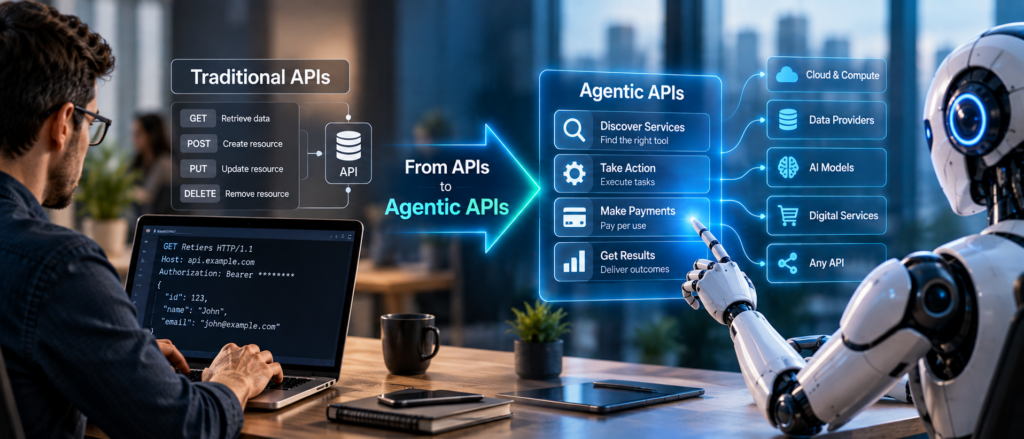
Traditional APIs are designed mainly for developers. A developer chooses an endpoint, supplies credentials and tells software exactly what to do. An Agentic API takes a more action-oriented approach. It helps an AI agent understand what it can accomplish and potentially discover and use services dynamically.
That matters because an autonomous agent might need to purchase a database query, obtain live market information or rent computing power. Instead of waiting for a human to arrange everything, the agent could discover the service, understand its terms and complete the task.
This is where agentic commerce enters the picture. Current research suggests the phrase itself is rapidly gaining search interest, with one 2026 analysis estimating around 5,600 monthly US searches and 464% year-on-year growth.
Enter the Smart Wallet
An AI agent that can make decisions but cannot pay for anything is rather like sending a very enthusiastic intern shopping without a wallet.
Agentic wallets aim to solve that problem.
Coinbase’s Agentic Wallets allow AI agents to hold, send and receive digital assets while developers can apply spending controls. Binance has also introduced an agentic wallet designed around a separate balance and configurable permissions. Privy is building similar infrastructure around programmable wallets and delegated authority.
The important idea is controlled autonomy, not simply handing an AI unlimited access to someone’s money.
An AI agent wallet can potentially become the financial identity of an autonomous software system. It can have funds, transaction limits and specific permissions while remaining separated from the user’s primary financial assets.
Why Businesses Are Interested

The attraction goes beyond shopping.
Imagine an AI agent needing a specialist API. The API costs a few cents. The agent checks the price, authorises the transaction through its wallet and receives the data.
Repeat that millions of times and an entirely new machine-to-machine economy starts to appear.
Mastercard’s Jorn Lambert has described machine payments as a way for services to be bought and sold between agents at a fundamentally different scale from today’s payments.
Coinbase executive Siddharth Coelho-Prabhu has similarly described agentic payments as one of the company’s high-conviction opportunities.
For developers, this could mean APIs becoming instantly purchasable services rather than products requiring lengthy account creation and subscription arrangements.
But Should We Let AI Spend?
Here comes the less glamorous — but much more important — question.
What happens when an agent misunderstands an instruction?
The International Monetary Fund has identified a fundamental tension between probabilistic AI behaviour and the deterministic requirements of payment systems. An AI may interpret an objective incorrectly even when the payment system executes its resulting instruction perfectly.
There are also concerns about fraud, prompt injection, stolen credentials, malicious tools and accidental overspending.
Then comes the biggest question of all: who is responsible?
If an agent buys the wrong product or transfers money to the wrong destination, should the consumer, AI developer, wallet provider, bank or payment network carry the liability?
There is no universally settled answer yet.
Trust May Be the Real Product

This is why the emerging industry architecture increasingly focuses on permissions and verification.
Google’s Agent Payments Protocol work and Mastercard’s agentic-payment initiatives are aimed at establishing mechanisms through which an agent’s identity, authority and transaction intent can be verified. Mastercard has also been developing agentic payment infrastructure specifically for machine-to-machine transactions.
Financial experts are cautious about consumer adoption too. Forrester analyst Lily Varon has described consumer interest in autonomous purchasing as still relatively lukewarm. Meanwhile Mastercard research indicates that only around one in ten consumers currently say they are willing to let an AI agent complete a purchase autonomously.
So the technology may be ready before the public is.
The Numbers Need a Reality Check
There is another wrinkle.
Large transaction numbers associated with emerging machine-payment protocols should not automatically be interpreted as millions of meaningful AI purchases. Recent independent analysis of x402 activity suggests that some reported payment volume may involve activity that is not genuine autonomous agent commerce.
That distinction matters.
A million transactions do not necessarily mean a million AI agents went shopping.
India Is Joining the Experiment
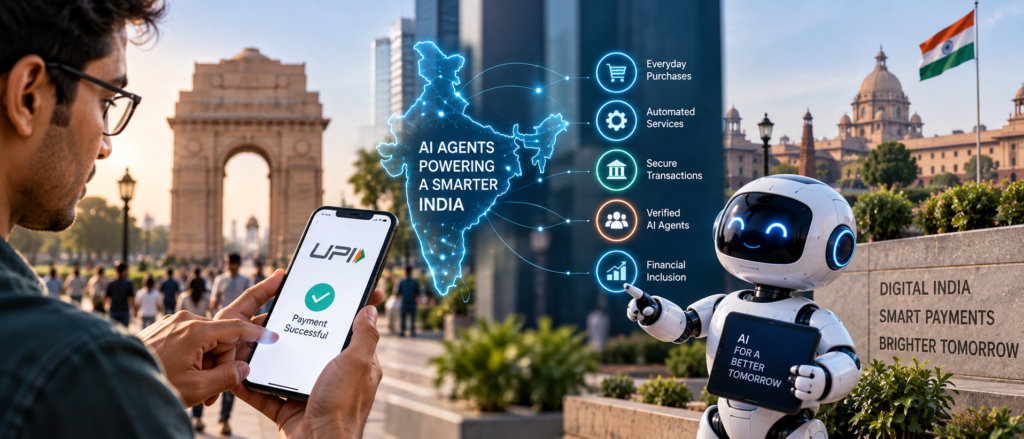
India could become particularly interesting because of UPI.
NPCI is working on mechanisms to identify and authorise AI agents conducting UPI transactions. Reuters reported in September 2026 that an AI-agent registry is being considered as part of India’s emerging agentic-payment infrastructure.
That could eventually allow an approved AI agent to perform small routine purchases while operating within defined rules.
Imagine telling an AI assistant: “Keep the household essentials stocked.”
The assistant could theoretically compare prices, select approved products and pay automatically.
Convenient? Absolutely.
A little terrifying? Also absolutely.
The Next Financial Interface?
Agentic APIs and smart wallets could create a new layer between humans and digital services.
The emerging model looks something like this:
Human sets the objective → AI agent makes decisions → Agentic API provides services → Wallet authorises payment → Payment network settles the transaction.
The technology is moving quickly. But the winners may not simply be the companies that build the smartest agents.
They may be the companies that make autonomous transactions safe, transparent, controllable and accountable.
The future of agentic commerce therefore may not be about removing humans from payments completely. It may be about giving humans the ability to say, “You can handle this,” while retaining the ability to define exactly what this means.
And that makes the humble AI agent wallet rather more interesting than it first sounds.