



Author: Rudranath Chakraborty
Modern working life often rewards people for being available rather than well rested. Long hours, late-night emails, commuting, screen exposure, irregular meals and work-related stress can gradually push sleep down the list of priorities. Against this background, longevity entrepreneur Bryan Johnson has made sleep one of the central pillars of his health routine. His message is simple: instead of treating sleep as the leftover part of the day, build the day around it.
Johnson’s approach is unusually disciplined. But the bigger question is whether ordinary workers can adopt the useful parts without having to reproduce his highly controlled lifestyle.
Why Johnson Puts Sleep First

Johnson describes sleep as the foundation supporting his nutrition, exercise, emotional resilience and wider longevity program. His current routine includes getting into bed at about 8:30 pm and waking naturally around 5 am. He has also reported achieving extremely high sleep scores through years of tracking and behavioral changes.
His protocol includes a consistent bedtime, a deliberate wind-down period, reduced evening screen exposure, controlled lighting, morning light, a cool and quiet bedroom, avoiding stimulants close to bedtime and finishing food well before sleep. He also tracks sleep and physiological data to identify patterns.
Some elements are distinctly personal. Johnson has described finishing his final meal many hours before bedtime and monitoring his resting heart rate before sleep. His own routine should therefore be understood as a personal experiment rather than a universal prescription.
What Sleep Specialists Actually Agree With

The interesting part is that many of Johnson’s basic principles are not particularly radical. Mainstream sleep guidance also recommends maintaining a regular sleep schedule, allowing enough time for sleep, limiting caffeine and alcohol close to bedtime, avoiding heavy meals near bedtime and keeping the bedroom quiet, cool and dark.
The American Academy of Sleep Medicine and Sleep Research Society recommend that healthy adults regularly obtain at least seven hours of sleep per night. They also recognize that individual sleep requirements vary.
This is where Johnson’s message becomes useful. The value may not be in copying his exact bedtime or measuring every biological variable. It is in recognizing that sleep deserves deliberate planning.
The Modern Worker Has a Different Problem

For a salaried office worker with predictable hours, a regular bedtime may be achievable. A freelancer working from home may have greater flexibility but struggle to separate work from personal time. A business owner may control the calendar yet remain mentally occupied until midnight.
The situation becomes more complicated for nurses, doctors, emergency personnel, factory workers, security staff, hospitality employees, drivers and people working rotating shifts. Their schedules may conflict directly with a fixed sleep pattern.
The National Heart, Lung, and Blood Institute specifically recognizes that shift workers can struggle to obtain sufficient sleep and suggests strategies such as protecting available sleep time, managing light exposure and limiting caffeine to the earlier part of a shift.
Parents and caregivers face another reality. Their sleep can be interrupted by responsibilities that cannot simply be moved to another time.
What Can Actually Be Borrowed?
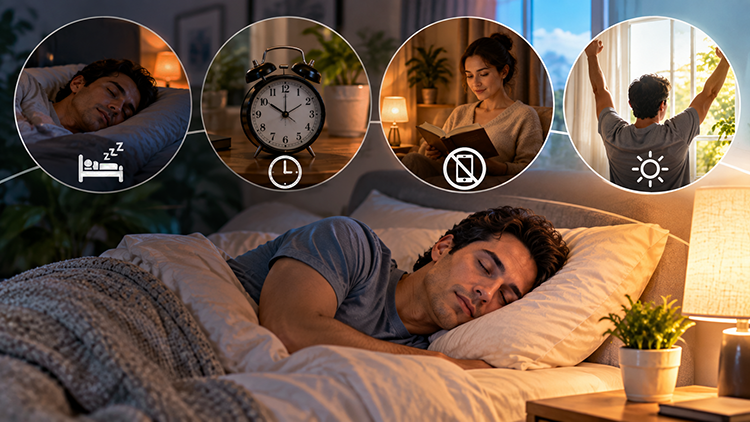
The most practical lesson is to separate Johnson’s principles from his personal routine.
First, establish a realistic sleep window that provides enough opportunity for seven or more hours where possible. Second, maintain reasonably consistent sleep and wake times. Third, create a short period before bed without work demands or stimulating digital activity.
Morning light is another practical habit. Light is an important signal for the body’s circadian system, and NHLBI guidance highlights daytime and particularly morning light as useful for regulating the sleep-wake cycle.
The bedroom itself also matters. A dark, quiet and cool environment requires neither expensive equipment nor sophisticated technology. Similarly, reducing late caffeine, nicotine, alcohol and heavy meals can be more realistic than attempting Johnson’s extreme dietary timing.
These are the foundations of sleep hygiene, and they can be adapted rather than copied.
Where Johnson’s Method Becomes Difficult
Johnson’s philosophy can become unrealistic when optimization itself creates pressure. Someone working until 10 pm cannot necessarily adopt an 8:30 pm bedtime. A parent may not have an uninterrupted evening wind-down. A night-shift employee cannot simply follow a conventional daytime schedule.
There is also a danger in turning wearable scores into the definition of good sleep. Tracking can reveal patterns, but a numerical target should not become another source of anxiety. Sleep is biological as well as behavioral.
For people with persistent insomnia or significant daytime sleepiness, lifestyle adjustments should not replace professional assessment. Stress and worry about sleep can themselves contribute to insomnia, according to NHLBI guidance.
A More Realistic Blueprint
The most transferable part of Johnson’s philosophy is not his expensive equipment, unusually early schedule or extensive measurement. It is the idea that sleep should receive the same planning given to work, exercise and meals.
For one person that could mean switching off the laptop at 10 pm. For another it could mean protecting a daytime sleep period after a night shift. For someone else it might mean avoiding late caffeine and keeping the bedroom dark.
That makes sleep for health less about copying Bryan Johnson and more about creating conditions in which the body can regularly recover.
His experiment raises an important question for modern society: if better sleep requires changing the way we organize our evenings, working hours and priorities, perhaps the real challenge is not knowing what healthy sleep looks like. It is creating a working life that allows people to achieve it.