

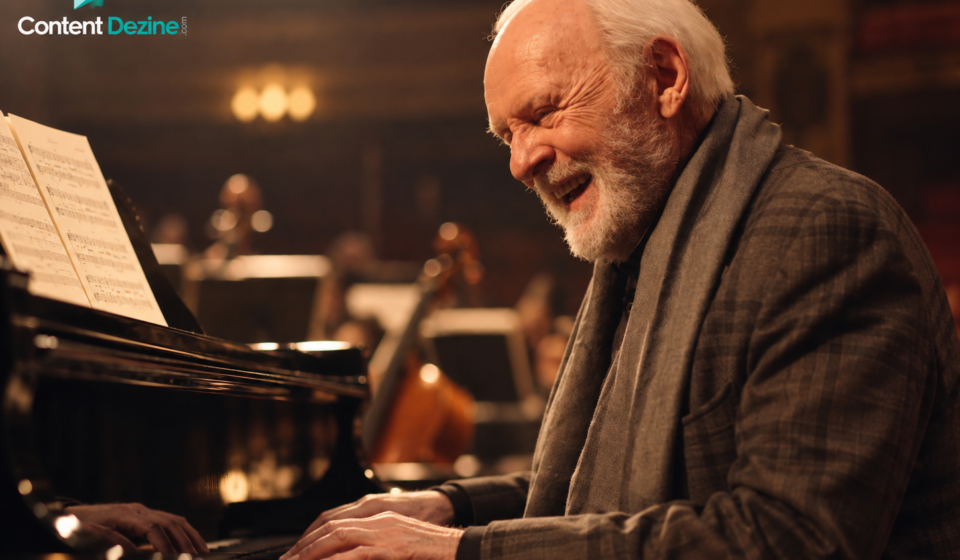
Sir Anthony Hopkins’ New Album Life Is a Dream: Will It Redefine the Legendary Actor’s Works?

Author: Rudranath Chakraborty
When André Rieu’s orchestra played Sir Anthony Hopkins’ And the Waltz Goes On in Vienna, the legendary actor was visibly overwhelmed. Hopkins had written the waltz in 1964, decades before his acting career made him internationally famous. His wife had secretly sent the score to Rieu, who arranged it for his orchestra. When Hopkins finally heard it performed, he reportedly told Rieu, “I love it, I love it, and I have tears in my eyes!” That emotional moment now feels like a preview of something much bigger. With Anthony Hopkins album Life Is a Dream, released by Decca Classics on August 21, 2026, Hopkins is no longer merely the celebrated actor with a hidden musical talent. He is presenting six decades of compositions as a serious body of work. The album, performed by the Philharmonia Orchestra under Gustavo Dudamel, has already reached No. 1 on the UK Official Classical Chart.
A Lifetime of Music Finally Steps Into the Light
Hopkins’ musical story began long before The Silence of the Lambs or The Father. He started playing piano at four, experimented with composition as a child and continued writing music alongside his acting career. As he puts it, “Music was my first desire, my first wish.”
Anthony Hopkins album Life Is a Dream therefore isn’t simply a celebrity attempting a second career. Its 12 compositions are fragments of Hopkins’ personal history—his Welsh childhood, family, memories, relationships and artistic influences. Bracken Road, for example, looks back toward his childhood in Margam, while My Fatherland honours his Welsh origins and his father, whom Hopkins describes as “the baker.”
Dudamel Sees More Than a Celebrity Project
The participation of Gustavo Dudamel changes the conversation considerably. The internationally acclaimed conductor describes Hopkins as an artist whose “creative voice transcends any single medium.” He says the same “imagination, humanity, and emotional truth” evident in Hopkins’ acting can be heard in his music.
Dudamel’s involvement matters because this is not simply an endorsement from a famous colleague. He conducted the compositions with the Philharmonia Orchestra, helping transform Hopkins’ private musical ideas into a large-scale orchestral recording.
Decca president Laura Monks similarly praised Hopkins’ “depth of talent and classical music knowledge,” describing the London recording sessions as a remarkable experience.
Musicians Hear a Storyteller Behind the Scores
The album’s pianist, Sergio Tiempo, has also been struck by the authenticity of Hopkins’ compositions. His assessment is important because he encountered the music as a professional musician rather than as a film fan.
The compositions are often described as cinematic, melodic and emotionally direct. That is hardly surprising. Hopkins spent his career communicating through character, atmosphere and dramatic tension. In music, he appears to have transferred the same instinct for storytelling from the screen to the orchestra.
Critics have noticed this too. The Guardian praised the album’s “easy-on-the-ear melodies” and its heartfelt character, while recognizing that its language is often closer to traditional orchestral and film music than experimental contemporary composition.
That qualification is important. Hopkins does not necessarily need to be judged as a new Beethoven or Mahler. His achievement may lie elsewhere: in creating music that communicates memory and emotion without demanding that the listener decode it.
Fame Is No Longer the Only Evidence
The album’s No. 1 position on the UK Classical Chart is an important development. Life Is a Dream reached the top immediately after release and remained at No. 3 in the following chart week, demonstrating that the initial attention was not merely a one-day publicity phenomenon.
But chart success alone cannot establish artistic importance. The more meaningful evidence is the combination of professional collaboration, critical engagement and the longevity of Hopkins’ compositions. And the Waltz Goes On had already travelled internationally through André Rieu’s performances, while Life Is a Dream now gives a much broader picture of the composer behind that famous waltz.
Could Music Change How We Remember Hopkins?
Perhaps the most intriguing question is not whether Hopkins can become a major classical composer. It is whether music will alter our understanding of the actor we already know.
For decades, Hopkins has been associated with some of cinema’s most psychologically complex characters. His music reveals another side—nostalgic, vulnerable, romantic and deeply connected to Wales and family.
That is why Life Is a Dream may ultimately become more than a late-career curiosity. Hopkins himself calls it his “most personal musical project,” and the album’s themes suggest a man looking backwards while still creating.
At 88, he has achieved something remarkably difficult: he has introduced an old passion to a new generation without abandoning the artistic identity that made him famous.
Whether Life Is a Dream becomes a lasting contribution to classical music remains uncertain. But perhaps that uncertainty is precisely what makes the album inspiring. Anthony Hopkins spent decades being recognized for pretending to be other people. Now, through music, audiences are being invited to hear the person behind the performances.
And perhaps his most unexpected role is only beginning.