


Author: Rudranath Chakraborty
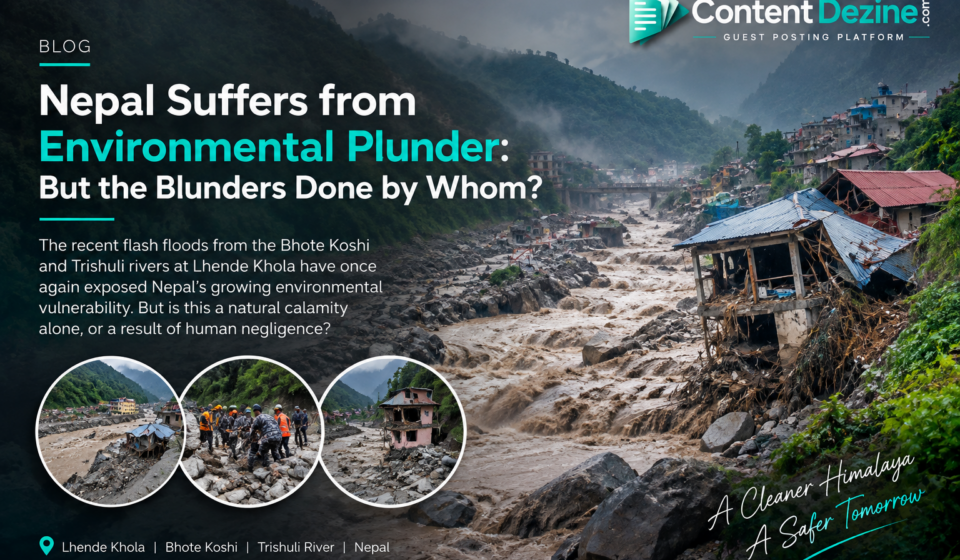
On 26 August 2026, the Bhote Koshi and Trishuli river corridors in Nepal became the scene of an extraordinary Himalayan catastrophe. An ice-and-rock avalanche and the temporary damming of the Lhende Khola unleashed a destructive flash flood that swept through settlements, roads, bridges and hydropower infrastructure. Nepal’s own health authorities describe the event as following an ice-and-rock avalanche and temporary river blockage north of the border.
But calling it simply a “natural disaster” may be too easy.
The tragedy has opened a much larger question: when an environmental disaster occurs in a region already under pressure from climate change, infrastructure expansion and fragile mountain ecosystems, where does natural risk end and human responsibility begin?
That question does not necessarily have one answer.
Nature May Have Started the Chain, But Humans Live Inside It
Scientists increasingly view the catastrophe as a cascading event rather than an ordinary flood. A mountain collapse can generate enormous quantities of ice, rock, sediment and water, transforming a river into a rapidly moving wall of debris.
The Financial Times has highlighted how warming Himalayan conditions, glacier retreat and weakening permafrost are increasing concern about such high-altitude failures.
Yet scientists have also urged caution. Nepal’s Foreign Ministry itself stated that the precise cause had “not yet [been] determined fully.”
That distinction matters. It would be scientifically irresponsible to declare that climate change alone caused this particular flood. But it would be equally irresponsible to ignore the changing environmental conditions in which such disasters are occurring.
So, Who Is Responsible?
Perhaps the uncomfortable answer is: there may not be one culprit.
Climate change is one part of the discussion. Global emissions have altered temperature and cryospheric conditions far beyond Nepal’s borders. Nepal contributes relatively little to global emissions but remains highly exposed to their consequences.
Then there is development.
Nepal’s economy depends heavily on hydropower, while roads, bridges, settlements and energy projects increasingly occupy difficult Himalayan terrain. The recent flood damaged numerous hydropower facilities and left workers trapped at several project sites. Reuters reported extensive rescue operations at hydropower projects across the affected region.
AP’s analysis has therefore raised a broader development question: should Nepal simply rebuild damaged infrastructure, or should future construction be redesigned around a changing climate and increasingly complex Himalayan hazards?
That is not an accusation against hydropower itself. It is a question about where, how and under what environmental assumptions infrastructure is built.
The Political Blunder May Be Different
Environmental responsibility and political responsibility are not necessarily the same thing.
The immediate political response has actually contained an unusual degree of cooperation. Nepal’s political parties called for stronger cross-border early-warning systems and a joint Nepal-China scientific mechanism to assess glacial risks. They also agreed to establish parliamentary oversight of recovery and reconstruction.
Political parties even mobilized their members for relief while asking them not to use party flags during distribution. The Kathmandu Post described this as a temporary move away from Nepal’s familiar government-versus-opposition political divide.
But unity during rescue can eventually give way to questions about accountability.
- Who knew what?
- Were warning systems adequate?
- Could vulnerable communities have received earlier information?
- Were infrastructure projects sufficiently risk-assessed?
- Were local governments equipped to respond?
And did the country have enough specialized equipment ready for a disaster involving flooded tunnels and collapsed hydropower facilities?
These are legitimate questions. They do not automatically establish negligence.
A Government Under a Different Kind of Pressure
Prime Minister Balendra Shah’s government is facing an early and difficult test.
The government has mobilized national resources and is coordinating with neighboring countries and international partners. Nepal’s Foreign Ministry continues to describe search, rescue and relief as the national priority.
But opposition politicians have also begun demanding stronger coordination and greater parliamentary oversight.
CPN-UML parliamentary leader Ram Bahadur Thapa called for special task forces for international assistance and reconstruction, as well as a mechanism bringing together political parties, civil society and experts. He also urged the prime minister to change what he described as a “unilateral style of governance.”
That criticism illustrates the political dilemma.
The government must act quickly enough to save lives, but it must also remain transparent enough to retain public confidence.
Climate Justice: Nepal’s Strongest International Argument
There is another side to this political story.
Nepal can legitimately argue that Himalayan communities are experiencing environmental consequences associated with a global problem to which they have contributed relatively little.
Prime Minister Shah has described the Bhotekoshi flood as a “serious signal” of rising climate risks and has called for global cooperation.
This gives Nepal an opportunity to take the catastrophe beyond domestic politics and into international climate diplomacy.
But climate justice cannot simply mean asking richer nations for money after every disaster. It must also mean investing that support intelligently—into glacier monitoring, early-warning systems, resilient infrastructure, safer settlements, scientific research and local preparedness.
The Border Cannot Stop an Avalanche
The disaster has also demonstrated something fundamental about Himalayan geography: nature does not recognize political borders.
The event affected both Nepal and China’s Tibet region. That makes information-sharing between the two countries more than a diplomatic courtesy.
Nepali political parties have already called for joint scientific and technical assessment of glacial risks along the border.
The same principle applies to India and other downstream countries.
If an event begins high in the Himalayas, the communities facing its consequences may have only a short window to react. A warning system that ends at a national border is therefore not a complete warning system.
The Real Blunder May Be Assuming the Old Normal Still Exists
Perhaps this is where the discussion becomes most important.
For decades, infrastructure planning has often relied on historical records to estimate future risks. But a changing climate makes the past an increasingly imperfect guide to the future.
AP’s reporting on Nepal’s hydropower vulnerability points toward the need for stronger risk assessments, better warning systems, backup power and more resilient infrastructure rather than simply replacing what was destroyed.
The question is not whether Nepal should develop.
It is whether development can proceed without treating the mountains as an unlimited construction zone and without treating yesterday’s climate as tomorrow’s guarantee.
Environmental Plunder or Environmental Warning?
The phrase “environmental plunder” carries a strong accusation. It suggests deliberate exploitation.
The evidence available today does not justify placing that label on one government, one political party, one country or one industry.
What the evidence does justify is a harder observation: human activity, climate change, infrastructure choices, insufficient monitoring and vulnerable settlements can interact with natural geological processes to produce disasters far more devastating than any one factor could create alone.
The environmental warning is therefore larger than Nepal.
The political warning is larger too.
Nature has delivered the message with extraordinary force. Now governments, developers, scientists and communities have to decide whether they will treat the event as an exceptional tragedy to be forgotten—or as evidence that the rules of Himalayan risk are changing.
A Message for the Future—and an Uncomfortable Uncertainty
Nepal does not need a convenient villain. It needs better science, transparent investigations, stronger early-warning systems, responsible infrastructure planning and cooperation across borders.
The victims should not become statistics, and reconstruction should not become an opportunity to repeat the same vulnerabilities.
Perhaps the most responsible question is not “Whose blunder was this?”
It is:
“What did we fail to understand, what did we fail to prepare for, and what will we change before the next warning arrives?”
The message is clear: the Himalayas are not silent, and the environment is not an unlimited resource.
But one uncertainty remains.
We still do not know whether the catastrophe of 26 August 2026 will ultimately be remembered as an extraordinary natural event—or as an early warning of a much more dangerous Himalayan future.