

Can Architecture Make Us Less Lonely? The Return of Shared Spaces in an Individualistic Age

Written by Rudranath Chakraborty
Loneliness is often discussed as a psychological or social problem. Increasingly, however, it is also becoming an urban question. The World Health Organization estimates that around one in six people worldwide experience loneliness. Its 2025 Commission on Social Connection also identifies social isolation and loneliness as significant threats to health and wellbeing.
This raises an overlooked question: can the places where people live make it easier to form relationships?
Architecture cannot manufacture friendship. A beautifully designed building will not automatically create a community. Yet the physical environment can determine whether people repeatedly encounter one another or remain separated behind doors, cars and screens. The emerging idea of urban design therefore goes beyond attractive buildings. It considers whether neighborhoods provide ordinary opportunities for people to see, meet and gradually recognize one another.
Libraries as Modern Social Infrastructure
The public library may be one of the clearest examples of architecture becoming social infrastructure. Libraries have traditionally been associated with books and quiet study. Increasingly, they function as meeting places, digital centers, classrooms, cultural venues and informal public living rooms.
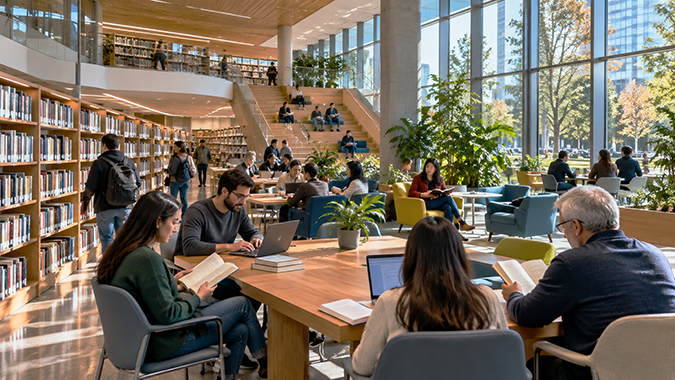
In the United States, the American Library Association reports that 61% of public libraries host social connection events for adults and 60% provide such events for teenagers. Almost all libraries also provide free public Wi-Fi.
Helsinki’s Oodi Central Library demonstrates how far this model can develop. The building combines traditional library services with workshops, meeting areas, public rooms, studios and spaces for informal gathering. Research on Helsinki’s Oodi and Maunula libraries found that flexible spatial arrangements can support social interaction between diverse groups.
The important point is not that people enter libraries specifically to make friends. It is that they enter for different reasons and share the same physical environment.
Courtyards and the Power of Casual Encounters
Some of the most socially important spaces are remarkably ordinary. A courtyard with benches, trees, shaded areas and somewhere for children to play can create something that private housing cannot: repeated low-pressure encounters.
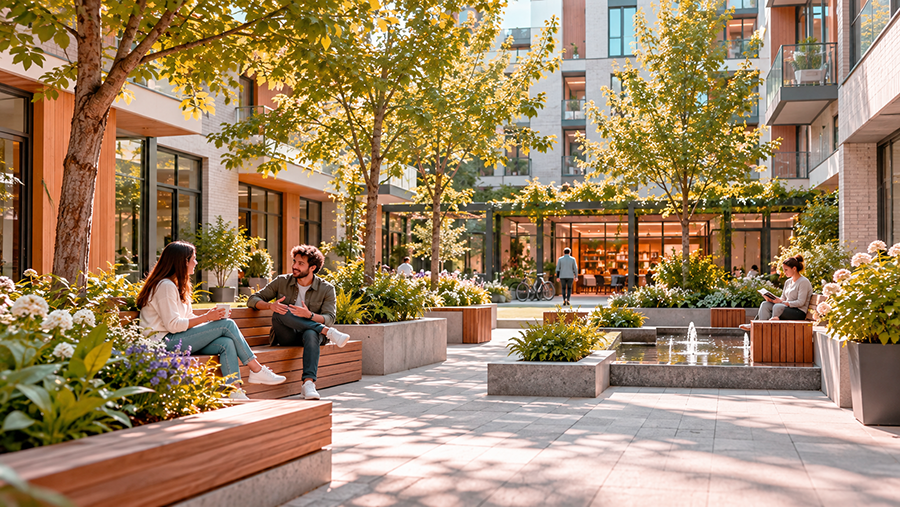
Research into neighborhood courtyards has found that these spaces allow residents to observe one another, exchange greetings and gradually become familiar. Their value lies partly in the fact that interaction does not require an invitation into somebody’s home. A brief conversation while passing through can become recognition, familiarity and eventually trust.
This is a crucial distinction. Communities are rarely created through a single dramatic social event. They are often built through repetition: seeing the same neighbor walking a dog, meeting another parent near a playground or exchanging a few words while sitting outside.
Good public spaces provide the stage for these small encounters.
Community Kitchens and Cultural Centers
Shared kitchens take the idea further by making cooperation part of the activity itself. Community kitchens can provide places where residents cook, eat, teach and learn together. Food creates a particularly accessible social language because participation does not necessarily depend on professional status, age or specialist knowledge.

Cultural centers work similarly. Exhibitions, performances, workshops and festivals can bring different groups into the same building without requiring them to belong to the same formal organization.
The OECD’s recent research on social connections describes libraries, parks, playgrounds, sidewalks, cafés, civic associations and other shared places as forms of social infrastructure. These environments can strengthen belonging and create opportunities for people from different social groups to encounter one another.
Coworking After the Office
The rise of remote work has created another architectural challenge. Working from home offers flexibility but can eliminate many of the incidental conversations once provided by offices.
Coworking spaces attempt to restore some of that social dimension. A study of independent professionals found that interaction in coworking environments can provide social support, while the spaces themselves offer opportunities for casual conversation and collaboration.

The lesson extends beyond offices. A shared environment does not have to force people into interaction. It can simply make interaction possible.
This principle is increasingly relevant to housing, where communal lounges, shared gardens, work rooms and multipurpose halls can provide intermediate spaces between the privacy of an apartment and the openness of a city street.
Mixed-Use Neighborhoods and the Return of the Local Center
A neighborhood becomes socially interesting when different activities overlap. Housing beside cafés, schools, shops, libraries, parks and cultural facilities creates more reasons for people to be outside at different times of day.
Recent research on mixed-use innovation districts in Singapore found that fine-grained urban environments and mixed-use strategies can promote activity integration and social interaction.
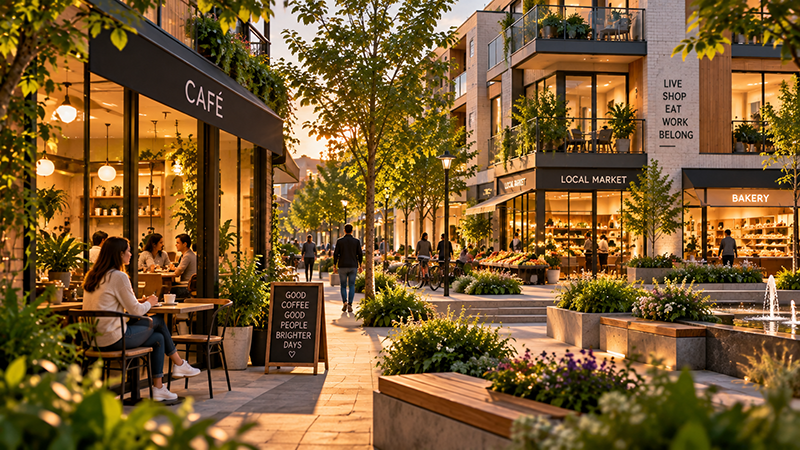
The growing interest in the 15-minute city reflects the same principle. Keeping everyday services within walking distance can increase local activity and reduce dependence on long journeys. Yet research also warns that proximity alone is not enough. A 2026 study found that neighborhood diversity matters because highly localized activity can otherwise create socially homogeneous “bubbles”.
That is where thoughtful urban design becomes important: not simply putting everything close together but ensuring that the resulting places remain accessible, diverse and genuinely shared.
Architecture Has Limits
There is a danger in believing that loneliness can be solved by construction alone. A plaza can remain empty. A cultural center can become unaffordable. A new development can have attractive landscaping while excluding lower-income residents.
The Urban Institute recently made a similar point: quality parks, libraries, plazas and streets can create opportunities for connection, but design alone cannot guarantee community. Resident participation, inclusion, programming and long-term stewardship also matter.
Research on adaptive communal spaces reaches a comparable conclusion. Community gardens, cultural hubs and other shared environments work best when residents have meaningful roles in shaping and managing them. Governance, funding and access can be as important as physical form.
Designing for the Possibility of Community
The most successful neighborhood may therefore not be the one with the most spectacular architecture. It may be the one that gives people more reasons to linger.
A bench positioned where people can see one another, a library with flexible rooms, a courtyard that feels safe, a community kitchen, a cultural center within walking distance or a mixed-use street can all increase the probability of casual encounters.
A 2025 study of public open space in three Canadian cities found that loneliness in its cohort increased by 5% between 2018 and 2020, while access to public open space showed a protective relationship with belonging, although not directly with loneliness.
That distinction matters. Architecture cannot promise friendship. What it can do is reduce the physical distance between people and create opportunities for familiarity.
In an age increasingly organized around individual homes, private screens and personalized services, shared space may become one of the most important forms of social infrastructure. The future of neighborhood architecture may therefore depend on a deceptively simple idea: design places where people have reasons to encounter one another often enough for strangers to become familiar, and familiar people to become a community.